
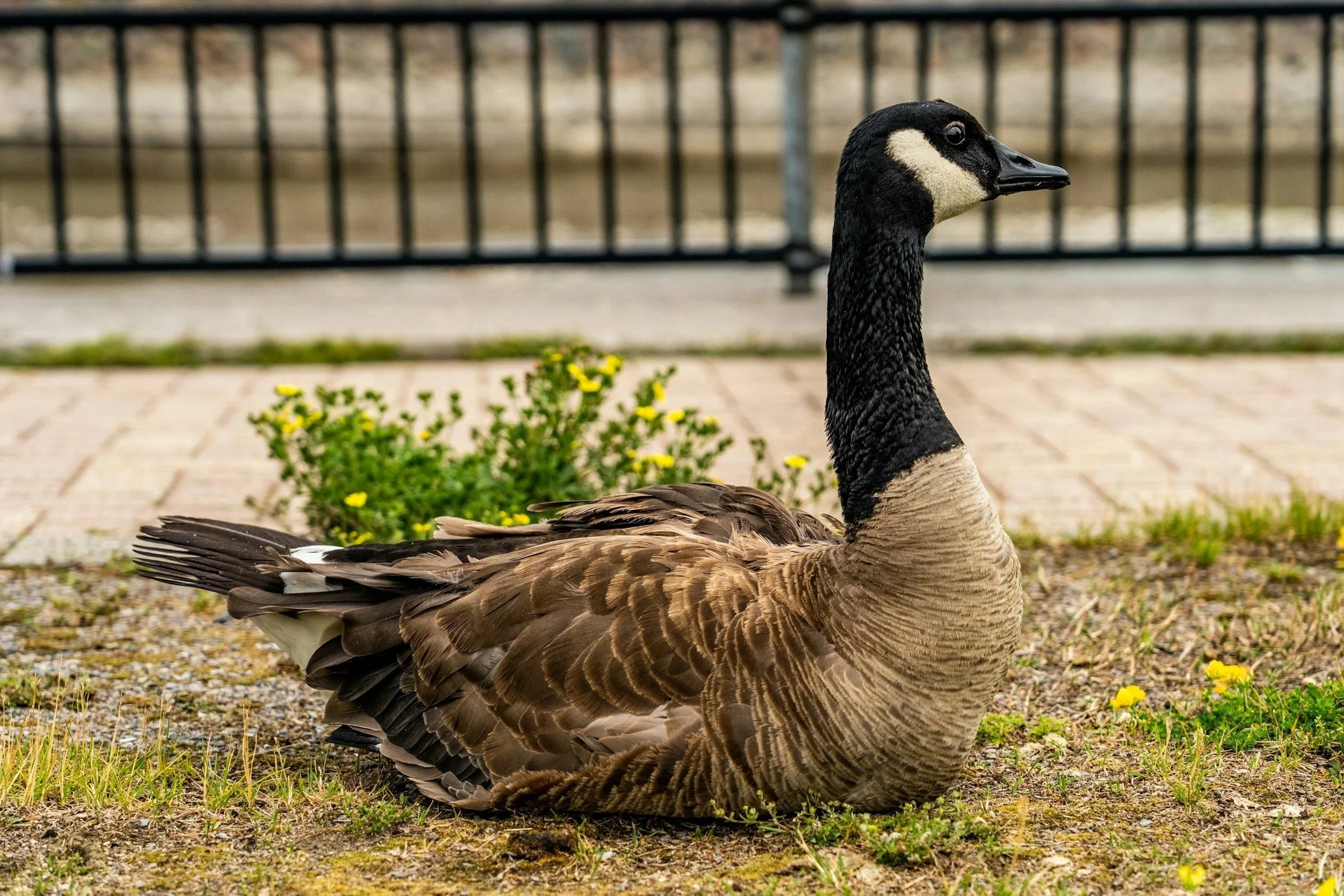
This is what the things can teach us:
To fall patiently, to trust our heaviness
Even a bird has to do that before he can fly.
—Rainer Maria Rilke (1875-1926)
With the coming of autumn Canada geese begin to once again announce themselves, flying over in scattered family groups, in training for the great migration south. They’ve been mostly quiet over the summer as they tend to domestic matters — mating, incubating, raising young, chasing predators, and fattening up on grass. Since the city birds are our neighbours, we’ve watched their offspring grow from downy goslings to gawky adolescents. Now they are young adults enjoying the thrill of flight. Soon it will be time to bid them farewell.
It seems such a short time ago in the spring when I heard the first Branta canadensis fly over my neighbourhood, to be followed by thousands more. Then, in early June, I witnessed something rather special.
I was on a nine-day retreat at Star of the North Retreat House in St. Albert. Alberta.
While Insight Meditation teachers Jeanne Corrigal and Kristina Baré officially led the retreat, there was a third unexpected teacher present. I noticed her sitting out a storm on a small overhang near the window of my room on the evening I arrived. Though lashed by rain and wind and thunder, she sat like a perfect little Buddha, unbothered, unmoving, so still that I took her to be a garden ornament at first.
Then she blinked. Her head moved slightly. Her body shifted a little, momentarily revealing a clutch of eggs. It was clear that mother goose would be sitting the retreat with us.
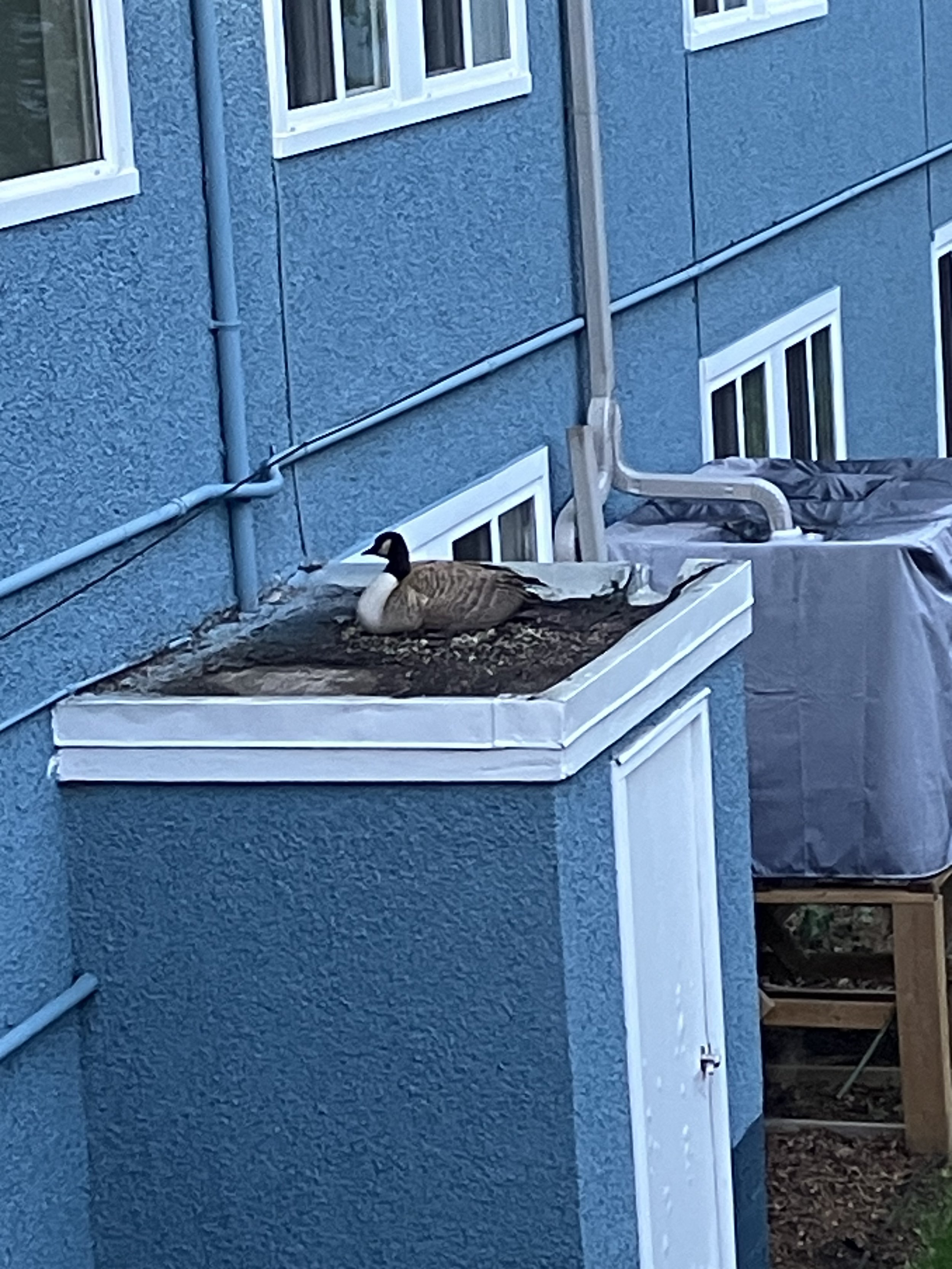
Mother goose on her makeshift nest at Star of the North Retreat House.
Jeanne opened her first dharma talk by saying that the Buddha learned everything he knew from nature. That statement startled me a bit but I realized it was true. Whether we are observing internal or external phenomena, we are studying nature. The behaviours of animals, plants, trees, rocks, weather, elements, human minds, bodies, civilizations and galaxies are all part of nature. The Buddha studied the nature of existence.
He was particularly interested in how to live in harmony with the facts of material existence — that conditioned things are fundamentally unstable. Yet stability is what we seek. Regardless of whether or not we regard ourselves as enduring spirit beings, our everyday experience is that of being in a temporary, unreliable earth body.
I doubt whether mother goose was thinking about any of that as she sat on her nest but some of us on retreat came to view her as a silent teacher. She reminded us of the need for patience, to allow things to happen in due time, to stay alert and present, to follow the laws of nature.
We were learning about samadhi — a state of mind characterized by peacefulness and bliss. Samadhi isn’t something you do or create; it’s something that arrives when conditions are right, according to the laws of nature. Samadhi comes and finds you when you are ready.
While samadhi is not the ultimate goal of meditation, a calm, happy, and steady mind is considered essential in realizing the main goal of liberation from dukkha (suffering). As Kristina put it, the relationship between samadhi and sati (or mindfulness, awareness) is like that between the arm and the needle of a vinyl record turntable. Samadhi is the arm holding the needle steady; sati is the needle tracking the record, which plays back the moment to moment “music” of life from which we gain insight into the nature of things.
Shamata practices are methods of calming the mind to induce samadhi. Kristina likened these practices to ingredients you put into a crockpot to make soup. The five ingredients that go into Samadhi soup are known as jhana factors. These are:
Vitakka or aiming. Aiming means directing your attention to a meditation object, like the breath, or metta.
Vicara or sustaining. Sustaining means keeping your attention on the object.
Piti or rapt attention, quiet joy. This is a feeling of delight that arises from attending to an object. Similar to being engrossed in a pleasant pastime.
Sukkha or contentment, satisfaction. A soft, restful kind of happiness.
Ekagatta or one-pointedness. Strong focus.
Mother goose seemed to me to embody samadhi. Her attention was sustained on her task of incubating, which she was evidently engrossed in. Though fasting, she bore whatever hunger and thirst were present with quiet stoicism and seemed content enough.
Each day I looked for signs the eggs were hatching. But a watched pot doesn’t boil and I eventually let go of the idea that anything would happen while we were on retreat. Goose eggs take 28 days to incubate. Who knew when they were laid? It seemed like a lot to expect them to break free at the same time as us.
And yet, that’s exactly what happened.
There can a sweet spot during a retreat when liberation becomes tangible. You adapt to the rhythms, calm settles over body and mind, fewer hindrances arise, a sense of spacious presence arises from within, you love everybody. There’s less getting caught in tangles of problem solving and worry, there’s more ease. There is some insight, something you may have known before cognitively is now known from a deeper, more embodied place. There is temporary release. Breaking free.
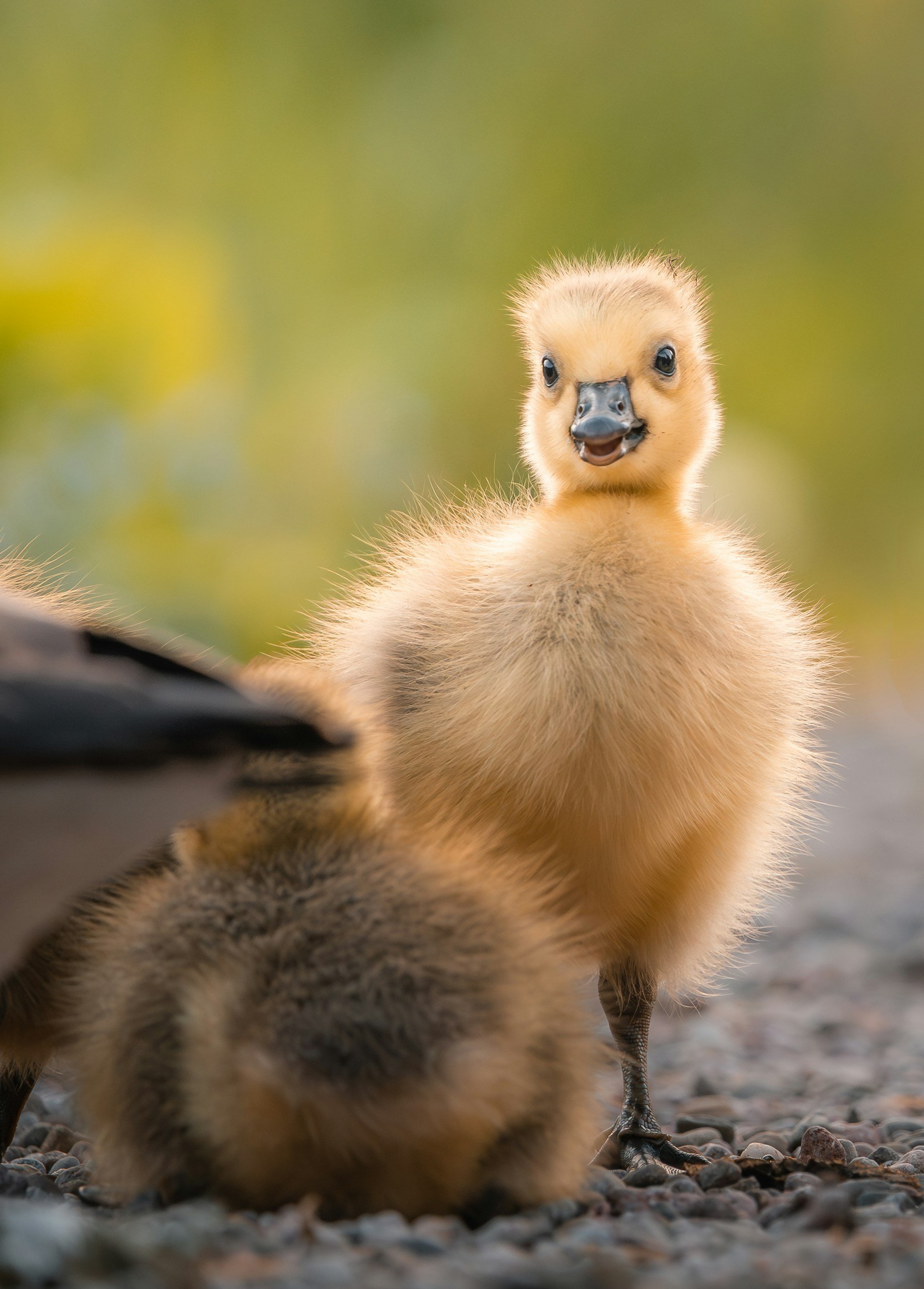
Stock image by bunty wild photography provided by Unsplash.
I was feeling this sense of temporary release on the morning of the seventh day. And when I looked outside of my window that morning, I was astonished to see that one of the goose eggs had in fact broken open. The shell, cleanly cracked in two, was sitting empty outside the nest, its former occupant moving about under its mom. A few more eggs hatched later that day, and a few more the next day, until all six emerged.
What were the odds of these goslings breaking out just as we were wrapping up our week of sitting meditation?
We were supposed to be in silence, but news of the hatchlings moved through the gathering of yogis like wild fire. Many watched at their windows as the new members of the family emerged. Father goose withdrew from his roof-top sentry post and took up dad duty on the ground as one by one, the goslings jumped about 10 feet from the overhang onto the grass and ran towards the shelter of his wings.
This is what the things can teach us:
To fall patiently, to trust our heaviness
Even a bird has to do that before he can fly.
—Rainer Maria Rilke
Nature being what it is, a happy ending is never certain. Two of the goslings apparently hatched too late to develop the necessary strength and confidence to fall patiently, to trust their heaviness. In my head though, I imagined that one had chosen to stay behind for the sake of the other. I observed one gosling peer over the ledge, seemingly thinking it over, then look back to its weaker sibling, as if to encourage. It reminded me of adult geese that remain on the ground with injured mates until they recover or die. Whatever the case, the two little ones ended up stranded on the roof, abandoned by their parents for the sake of the four goslings who would die if they didn’t get food and water soon. They had a long waddle ahead of them, for the river was a long way off.
In response, a small team of yogis with ladders and a cardboard box staged a rescue and brought the two orphans to a nearby veterinary office that handles wildlife. People meditating with open hearts are not going to leave two newborns to die. Nature was not going to take its course on our watch.
I don’t know what happened to the baby geese after we left, but I’d like to imagine they survived. I gave them names — Sati and Sami. I’d like to think the trauma of their being plucked from the nest and placed temporarily in the alien world of humanity was made more bearable for having each other.
Maybe they were released and adopted by another family — a common practice among geese. Even now, as I write this on a mid-September morning, I imagine Sati and Sami soaring over the prairie together, happily gaggling as they flex their wings, sensing the excitement of the grand journey ahead.
Yes, their lives are fraught with danger and uncertainty and they will die one day, as will we.
But what an adventure!
—Nelle Oosterom
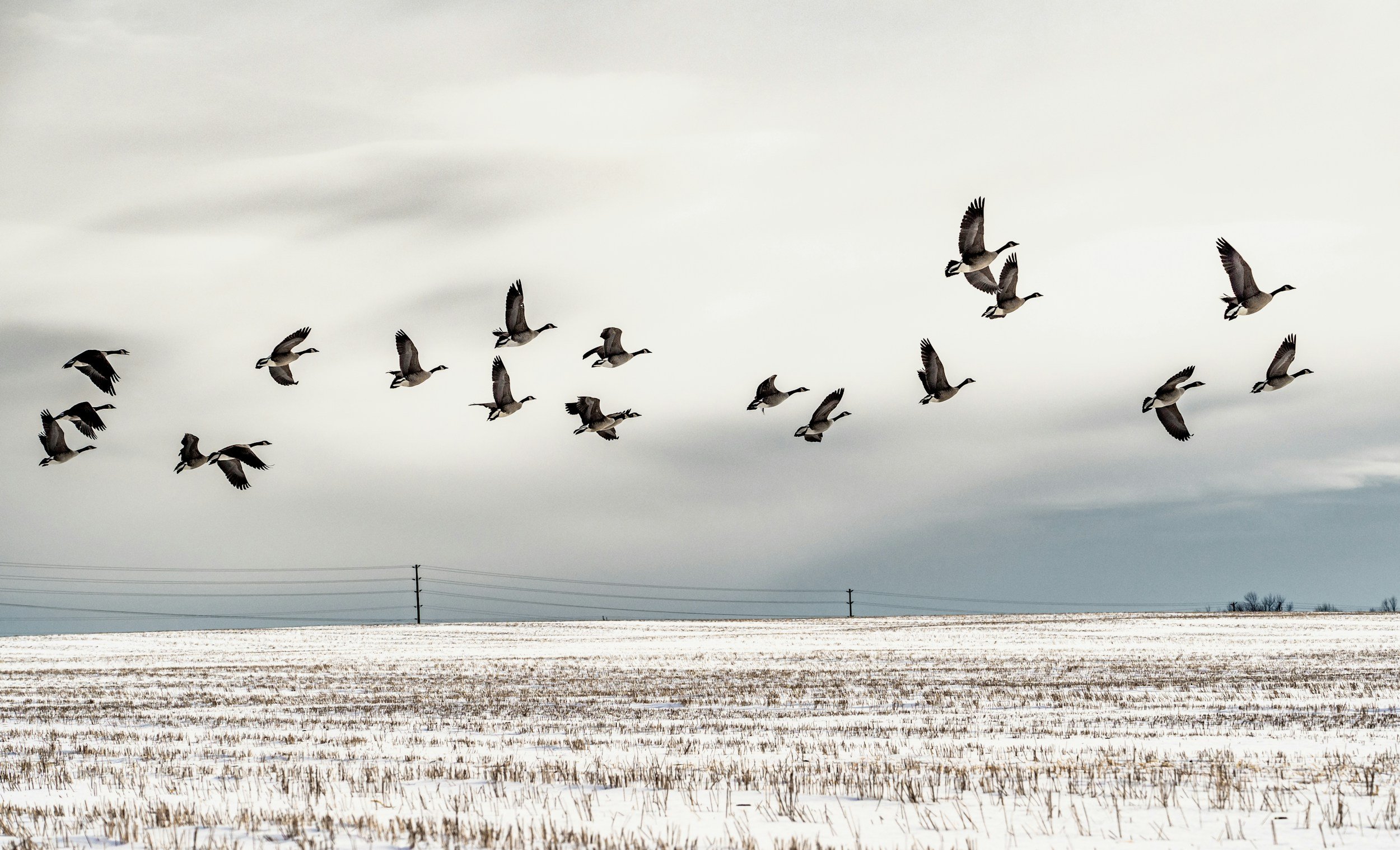
Stock image by Chris Robert provided by Unplash.